Growth in HoReCa comes with a less visible challenge: operational complexity. As a group expands, systems that once worked start to become limiting, and the lack of integration begins to impact speed, consistency, and decision-making.
This case study shows how City Grill Group moved from fragmented systems to a fully integrated digital ecosystem built on Breeze—and how this transformation directly contributed to growth, operational efficiency, and the development of a loyalty channel that now generates 28% of total revenue.
When growth puts pressure on existing systems
City Grill Group, founded in 2004, is a major player in Romania’s hospitality industry, operating a diverse portfolio of restaurants, cafés, event venues, and hospitality projects. The group brings together iconic brands such as Caru’ cu Bere, Hanu’ lui Manuc, Hanu’ Berarilor, Pescăruș, City Grill, and Buongiorno, alongside newer names like Aubergine and Marty Restaurants.
This portfolio functions as an integrated ecosystem, where each brand has its own identity but shares the same need: operational consistency and a relevant customer experience.
The partnership with BitSoft began in 2011, with the implementation of Oracle Micros and Materials Control solutions, which supported the group’s operations during its early growth stages.
However, as the portfolio expanded and the business became increasingly dynamic, this complexity started to put direct pressure on the technological infrastructure. Existing systems were still functional, but no longer kept pace with the business. Data was fragmented, reporting was delayed, and every important decision required manual effort to aggregate and interpret information.
In a business where speed and consistency are critical, this type of limitation quickly becomes a bottleneck.
The turning point: from systems to platform
In 2016, City Grill made a strategic decision: migrating to Breeze.
This was not about replacing one POS with another, but about transforming how the entire business operates. Choosing a cloud-based solution meant, first and foremost, access to real-time data from anywhere. More importantly, it enabled the creation of a coherent system where all components communicate seamlessly.
The modern interface and tablet-based operations brought a visible upgrade to the restaurant teams’ experience. However, the real value came behind the scenes: in how data started to flow and turn into actionable insights.
Building an ecosystem
After implementing Breeze POS, the transformation naturally extended to integrating all critical operational areas.
Inventory management was migrated to KeepAPP, eliminating dependency on a legacy system and providing much more precise cost control. At the same time, kitchens were optimized through KDS, while digital ordering capabilities expanded through eCommerce and ServUs.
Later, the ecosystem was enhanced with marketing automation software, and more recently, the in-location experience was extended through kiosks in high-traffic airport areas.
The result is not a collection of tools, but a unified system where every interaction – from order to analysis – generates data that can be further leveraged:
- Breeze POS
- KeepAPP (inventory & cost control)
- KDS (kitchen optimization)
- eCommerce
- ServUs (ordering digital)
- Loyalty Mobile App (Out4Food)
- Marketing Automation
- Kiosk
The outcome: all operations run within a connected ecosystem, with unified data.
Visibility that transforms decision-making
One of the most important outcomes of implementing Breeze is the shift in how teams make decisions.
Previously, reporting was largely retrospective. Today, management has real-time access to the performance of each location, can compare results across restaurants, and quickly identify deviations or opportunities. This visibility doesn’t just mean more data—it enables a different type of control: an active one, allowing fast interventions and fine-tuned operational adjustments.
In a group with multiple concepts and locations, this capability becomes a real competitive advantage.
Operational efficiency as a result of integration
System integration has significantly reduced operational friction. Processes have become more standardized, errors have decreased, and teams can work more smoothly without switching between different systems. In the kitchen, workflows are clearer and faster. Front-of-house, orders are processed more efficiently. In the back-office, cost and inventory control are far more precise.
Each individual improvement may seem small, but together they fundamentally change how the business scales and generates profit.
Loyalty transformed into a growth channel
One of the most visible areas where Breeze has had an impact is customer relationships.
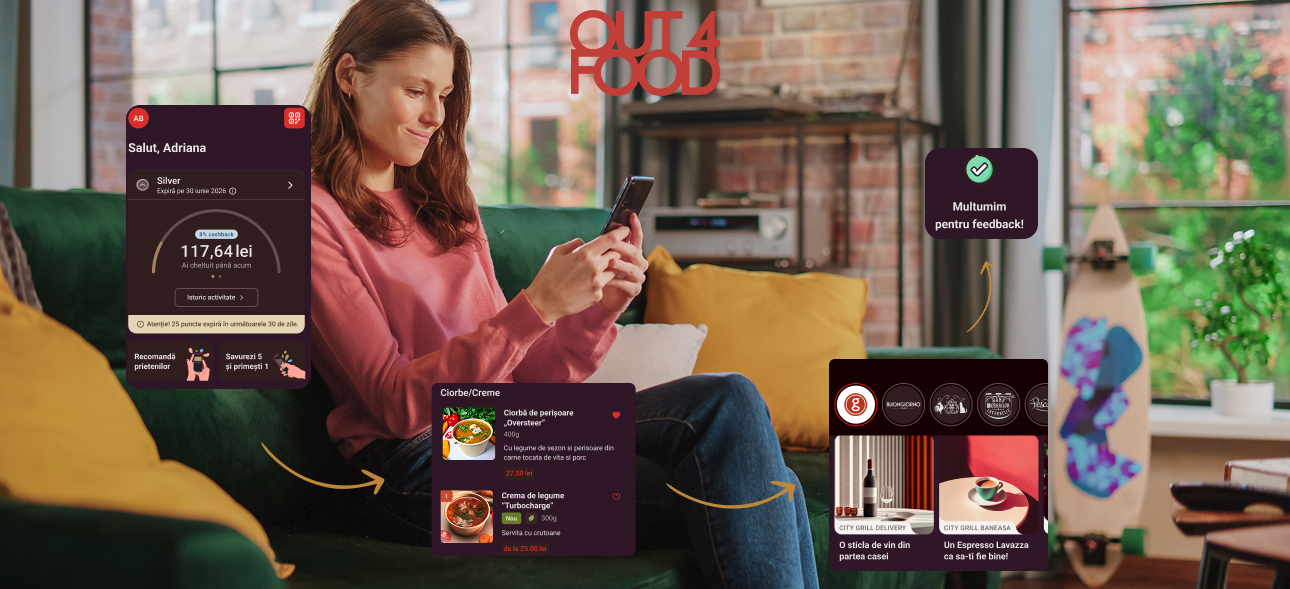
The Out4Food app, built on the Breeze Loyalty Mobile App infrastructure, is not just an engagement tool—it is a direct revenue channel. With 380,000 active users and contributing 28% of the group’s revenue, loyalty has become a true business driver.
Moreover, user behavior within the app clearly demonstrates the value of personalization: the average check value is approximately 20% higher compared to customers who do not use the app.
Through features such as favorites and personalized recommendations, the experience becomes faster, more relevant, and better aligned with modern consumer expectations.
“Loyalty is no longer just an engagement tool, but a real growth channel. With Out4Food, we moved from mass campaigns to personalized communication based on each customer’s behavior. Today, we clearly see the impact in visit frequency, average check value, and most importantly, in long-term relationships with our guests.” – Ramona Popescu, Head of Marketing and Customer Experience
Technology as the infrastructure for growth
The group’s financial evolution reflects this transformation:
From approximately €56.5 million in 2023, to €68 million in 2024, and €90 million in 2025, City Grill has entered a phase of accelerated growth.
Of course, this evolution is the result of a broader strategy: investments in new locations, new concepts, and brand positioning. But without a technological infrastructure capable of supporting this level of complexity, scaling would have been significantly more difficult.
In this context, Breeze is not just an operational tool – it is the foundation that enables controlled growth.
From operations to experience
City Grill’s strategy for the coming years is built around the concept of experience – whether we’re talking about modern concepts targeting younger generations or locations with strong historical identity. In both cases, technology plays a key role, even if it is not directly visible to the customer. It ensures consistency, personalization, and the ability to scale without losing control.
The City Grill story shows that digitalization in HoReCa is no longer about implementing isolated solutions, but about building a coherent ecosystem.
Through Breeze, the group has successfully connected its operations, transformed data into decisions, and taken loyalty to the next level – resulting not only in greater efficiency, but also in sustained growth.