When Subway France set out to transition its technology stack in 2024, the objective was to move away from the legacy software provided by Subway LLC, under a tight operational deadline and with local requirements that demanded flexibility, speed, and deep integration.
The initiative was not driven by dissatisfaction with the existing solution, but by the need to identify a viable, future-proof replacement that could support both current operations and new digital ambitions at local and regional level.
Subway France was not looking for a single tool. They needed a complex, integrated ecosystem capable of running a nationwide network reliably, while also enabling new customer experiences, especially loyalty, automation, and fully digital equity store journeys
A competitive selection process: pilots, incumbents, and challengers
To make the right choice, Subway France evaluated three solutions in parallel.
Two new competitors, Breeze and a French supplier, each deployed their solution in three pilot locations. In parallel, the existing solution already used in Subway France, inherited from Subway LLC, was also evaluated as part of the decision process, without the need for an additional pilot.
This setup allowed Subway France to compare solutions in real operating conditions, assessing stability, usability, rollout readiness, integration capability, and alignment with both Subway LLC standards and local operational realities.
Why Breeze was selected
Breeze was selected based on a combination of functional depth, usability, and execution capability.
The best balance between quality and price
Breeze delivered enterprise-grade capabilities without the cost structure or rigidity typically associated with legacy or international platforms. This made large-scale rollout financially sustainable while still meeting Subway’s operational and strategic requirements.
A friendlier, easier-to-operate experience for restaurant teams
Ease of use in real restaurant conditions was a critical factor. Breeze proved intuitive for in-store teams, reducing training effort and minimizing operational friction, an essential requirement when deploying across hundreds of locations under tight timelines.
The most developed and complete system
Compared to other shortlisted vendors, Breeze offered the broadest functional coverage, addressing every major area of the business within a single ecosystem: operations, ordering, kitchen workflows, loyalty, marketing automation, data, and centralized management. This reduced dependency on multiple vendors and ensured long-term consistency.
Proven experience and operational expertise
Beyond software features, Subway valued Breeze’s hands-on experience in restaurant operations, especially in complex, high-volume environments. This operational understanding translated into faster alignment, more relevant solutions, and practical decision-making during rollout.
Flexibility and speed of adaptation
Requirements evolved continuously throughout the project. Breeze demonstrated the ability to adapt quickly, delivering customizations, new integrations, and workflow adjustments as needed, often while deployment was already underway.
Together, these factors positioned Breeze not just as a software platform, but as a capable execution partner, able to support Subway France through a high-pressure migration, ongoing evolution, and future growth.
Deployment under pressure: migrating hundreds of locations in under 6 months
Once Breeze was selected, the most difficult phase began: execution.
At the moment of selection, Subway France had approximately eight months remaining to complete the rollout, with the most intensive deployment phase concentrated in under six months across more than 370 locations, all while restaurants continued operating daily.
This was not a standard implementation. The rollout required multiple integrations developed in parallel, including integration with the existing loyalty system during the transition period, integration with the centralized reporting systems of Subway LLC, integration with the centralized reporting systems of RexSubs, the master franchisee for France, Benelux, and the Czech Republic, and integration with the logistics systems of STEF in France. Additional local and operational integrations were delivered as needs emerged.
The rollout also required customizations specific to Subway France and took place in a context where both systems and processes were evolving in motion.
This was not a plug-and-play migration. It was an accelerated transformation where deployment, integrations, and operational alignment happened in parallel, without compromising the daily operational routine of restaurants.
To simplify execution at scale, the project included shipping all required hardware from Romania for every location, along with structured packaging, accessories, and how-to video guidance to minimize friction for on-site teams.
Digital equity stores: built for Subway’s “made-to-order” model
A major milestone was the launch of Subway France’s first fully digital equity stores, built on standardized and centrally managed processes. This model was deployed selectively in 12 locations, chosen specifically to support a fully automated customer journey from ordering to production.
Designing these stores came with a fundamental challenge: Subway is not a typical fast-food operation.
Unlike restaurants where customers choose from a predefined menu and only adjust small options, Subway is fundamentally made-to-order. Each sandwich is customized in real time: bread, ingredients, sauces, add-ons, and the operational flow must reflect that complexity.
To support this model, Breeze Kiosk and Kitchen Display workflows were optimized specifically for Subway’s way of producing orders.
The operating flow was defined during a hands-on workshop in Toulouse, bringing together Subway and Breeze management teams. The objective was not to design an abstract “ideal journey,” but to map real production behavior, customer pacing, and kitchen organization, turning the concept of a fully digital store into a practical, repeatable operating model.
To make digital ordering work seamlessly with Subway’s made-to-order production model, both the customer-facing ordering flow and the kitchen setup were optimized. This included operational refinements such as:
- A fully redesigned Kiosk interface, tailored to Subway’s customization-heavy ordering process, guiding customers step by step through bread, ingredients, sauces, and add-ons in a clear and intuitive way
- A KDS flow adapted to Subway’s production steps, reflecting the real sequence of sandwich preparation, and creative KDS experiments such as solutions where orders were repeated to kitchen staff through headsets to improve speed and accuracy.
- A specific thermal printer selected to produce high-resistance labels that stick reliably to oven paper packaging, allowing sandwiches to be tracked through heating and accurately matched to the order number
These details matter in a fully digital environment: when customers don’t interact with staff, the operational system must carry the load: identification, sequencing, and accuracy must be guaranteed by process + tooling.
Data visibility as a foundation for decision-making
A key component of the project is the implementation of the first phase of Breeze AI Analytics, providing Subway France with a consolidated, daily view of operational performance across the network.
The analytics layer delivers structured, centralized dashboards based on daily data aggregation, significantly improving visibility compared to the previous fragmented reporting setup.
- Through centralized dashboards, teams can:
- Compare individual restaurant performance against regional benchmarks
- Analyze results versus national averages
- View aggregated data across selected groups of restaurants or at country level
This transition from disconnected reporting to standardized, daily consolidated dashboards enables more consistent performance tracking, clearer benchmarking, and more informed operational decision-making across the network.
The next development phase will extend this foundation toward real-time data processing and advanced AI-driven insights.nd a clearer understanding of performance across the entire network.
SUB LIKE ME: loyalty built around the customer
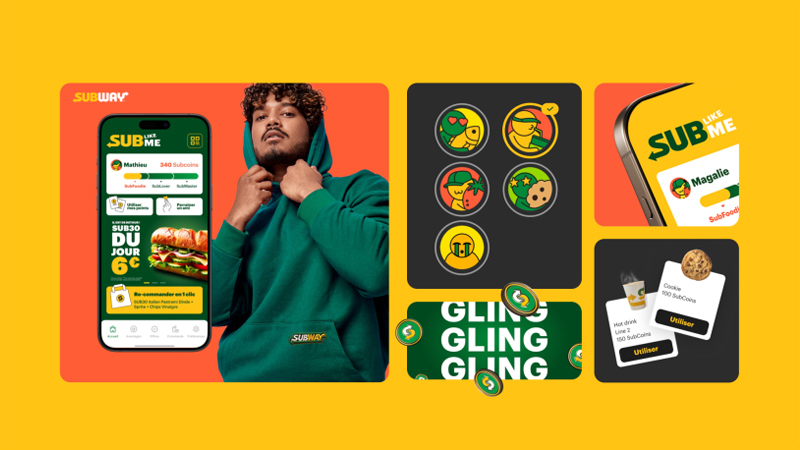
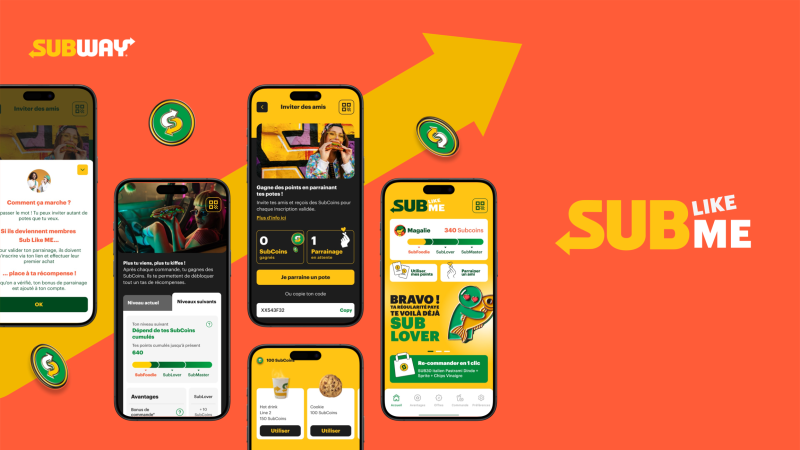
Digital operations were complemented by a new loyalty experience: SUB LIKE ME, built on Breeze mobile application developed and rolled out nationally.
Within the first months, the loyalty program became a meaningful revenue driver, accounting for up to 10% of total transactions across all ordering channels, with consistent organic growth over time.
At the heart of SUB LIKE ME is a tier-based loyalty structure: SubFoodie, SubLover, and SubMaster, designed to reward engagement over time. Interactive elements allow users to express their “Subway personality”, while future updates will introduce badges, challenges, and experiential rewards.
Lifecycle marketing executed at scale with Marketing Automation
Behind the scenes, Subway France runs its loyalty and CRM strategy using Breeze marketing automation solution for restaurants.
Rather than treating marketing as a series of isolated campaigns, Subway designed a full lifecycle marketing framework, fully implemented in Breeze. Today, over 100 campaigns are configured in the system, active and recurring or activated contextually for seasonal or one-time initiatives.
Campaigns cover the entire customer journey, from onboarding and loyalty progression to cross-sell, reactivation, and life moments such as birthdays or anniversaries. Breeze acts as the execution engine, ensuring consistency, automation, and scalability across hundreds of restaurants.
What it takes to modernize a QSR network at scale
Subway France’s experience shows what’s required when a large QSR network wants real change, fast:
- Selecting the right partner through real-world pilots
- Migrating an entire network under a hard deadline without compromising operational daily routine
- Building integrations and custom requirements “in motion”
- Launching fully digital stores only where the operational model supports it
- Developing loyalty as a product, not a one-time feature
- Running lifecycle marketing as a system, with automation at its core
This wasn’t a simple rollout. It was a high-speed rebuild of operations and customer engagement, where the technology had to flex, and the results had to land while restaurants kept serving customers every day. This project stands as a clear example of how technology can support long-term growth, operational clarity, and deeper customer relationships in modern restaurant networks.